Designing for the Unknown
What design education reveals about this generation’s hardest challenge and what the research says about why it matters.
Inspired by a conversation with Professor Nirali Parekh Soni – founder of Nirali Design Studio, educator at Anant National University, and author of The Pause Between Architecture and Being and Designer of My Life.
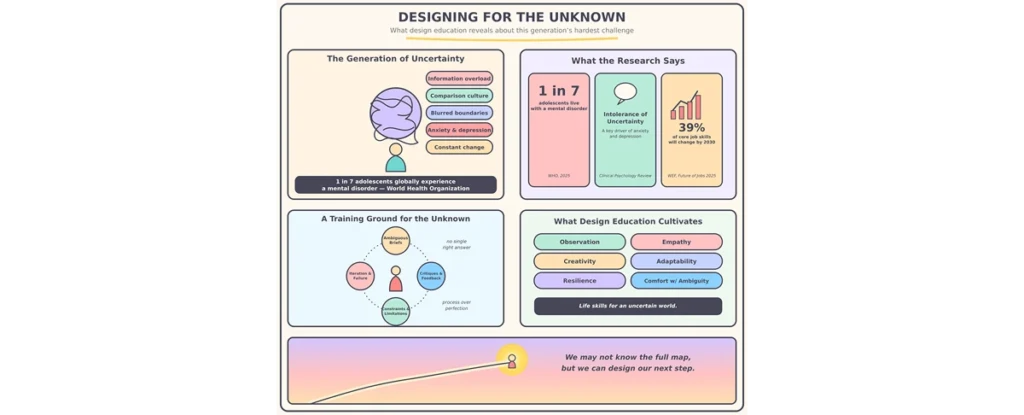
A snapshot of the study: the generation, the research, the design-school habits behind the argument, and where it leads.
What if this generation’s biggest challenge isn’t too little information, but too little comfort with not knowing? That question kept resurfacing in a recent conversation with Professor Nirali Parekh Soni, who argues in her book Designer of My Life that we are all designers constantly choosing, adapting, and responding to change. Seen this way, today’s mental health crisis and design education’s oldest habits turn out to be closely connected.
What if the real challenge isn’t a lack of information or opportunity, but an inability to comfortably navigate uncertainty?
The Generation of Uncertainty
Anxiety, burnout and depression are now part of everyday vocabulary for young people. The World Health Organization reports that 1 in 7 adolescents globally live with a mental disorder. Add constant connectivity, comparison culture and blurred lines between work and rest, and it’s no surprise this generation feels overwhelmed even as it is asked to make life-defining decisions while the ground keeps shifting underneath it.
What the Research Says
Psychologists call this intolerance of uncertainty: the tendency to find not-knowing itself threatening. It is one of the most consistently replicated findings in clinical psychology, cutting across anxiety, depression and obsessive patterns alike. During the pandemic, researchers found that a person’s baseline intolerance of uncertainty predicted roughly a quarter of their later anxiety and depression symptoms.
The uncertainty isn’t only emotional it’s structural. The World Economic Forum estimates that 39% of core job skills will change by 2030. Today’s students are training for roles and tools that don’t fully exist yet, and won’t stay the same for long.
Design Education as a Pedagogy of Uncertainty
For anyone who has gone through design education, uncertainty is almost the curriculum itself:
- The design brief is ambiguous.
- There is rarely a single correct answer.
- Ideas are repeatedly questioned.
- Failure is expected.
- Iteration is necessary.
- Critiques challenge assumptions.
- Constraints become opportunities.
Design education doesn’t train people to avoid uncertainty, it trains them to work inside it. Psychologists call the underlying skill tolerance of ambiguity, first described by Else Frenkel-Brunswik in the 1940s. Decades later, researchers found that design students who scored higher on this trait also scored higher on creativity. Some borrow a phrase from the poet John Keats to describe it: negative capability the capacity to sit with uncertainty without rushing to resolve it.
What Design Education Cultivates and Why It Works
Professor Soni believes this may be design education’s most relevant lesson for this generation. Three ideas from psychology explain why it works so well:
- Self-efficacy (Albert Bandura): believing your actions shape outcomes builds persistence through setbacks.
- Growth mindset (Carol Dweck): treating failure as feedback, not a verdict, improves performance over time.
- Reflective practice (Donald Schön): good designers don’t solve fixed problems they reframe them as new information emerges.
From Studio to Society – What We Need to Do
Perhaps it’s time these habits moved beyond the design studio. Children and young adults need real room to ask questions without rushing to answers, and to fail without fear of judgment. In practice, that means:
- Introducing design thinking early, before exam pressure sets in.
- Making space to explore, not just to perform.
- Rewarding good questions, not just fast answers.
- Normalising failure as part of learning, not the end of it.
- Teaching students to navigate complexity, not just solve for one right answer.
None of this requires a design degree just deliberate practice, treated as seriously as we already treat reading or arithmetic.
We Are All Designers of Our Lives
Design education, at its best, isn’t really about designing objects or spaces. It is an education in navigating complexity and continuously redesigning oneself in response to change. Life, like design, rarely offers a finished blueprint only incomplete information and shifting context. We may not know the full map. But we can always design the next step.
About This Conversation

| This piece draws on a conversation with Professor Nirali Parekh Soni, founder of Nirali Design Studio and an educator at Anant National University. Her books, The Pause Between Architecture and Being and Designer of My Life, explore how design thinking can reshape the way we move through our own lives. The research woven through this piece is added to ground her observations in the wider literature on uncertainty, ambiguity and resilience. |
Sources
- World Health Organization. Mental health of adolescents (fact sheet). 2025.
- World Economic Forum. The Future of Jobs Report 2025.
- Research on intolerance of uncertainty as a risk factor for anxiety and depression. Clinical Psychology Review; BMC Psychiatry (2023); Frontiers in Psychiatry (2023).
- Frenkel-Brunswik, E. Intolerance of ambiguity as an emotional and perceptual personality variable. Journal of Personality, 1949.
- Tracey, M. W., & Hutchinson, A. S. Introducing Negative Capability to Design Thinking: Ambiguity Tolerance in the Design Studio.
- Kelley, T., & Kelley, D. Creative Confidence: Unleashing the Creative Potential Within Us All. Crown Business, 2013.
- Dweck, C. S. Mindset: The New Psychology of Success. Random House, 2006.
- Schön, D. A. The Reflective Practitioner: How Professionals Think in Action. Basic Books, 1983.