Beyond the Metros: How Businesses Can Scale Across Tier-II and Tier-III Cities
For many growing businesses in India, expansion once meant entering another metro city. Delhi-NCR, Mumbai, Bengaluru, Hyderabad, Chennai and Pune were often the first choices for brands planning new stores, cafés, clinics, offices or experience centres.
That growth pattern is changing.
Tier-II and Tier-III cities are becoming increasingly important for organised retail, cafés, QSRs, wellness businesses, clinics, franchise brands and other consumer-facing companies. Better connectivity, improving infrastructure, digital exposure and changing customer expectations are encouraging businesses to look beyond traditional metro markets.
But for a growing business, entering a new city raises an important question: How can you expand without turning every new location into a completely new project?
Opening One Location Is Easy. Repeating It Is the Real Challenge
Launching the first outlet usually gets plenty of attention from the founder and core team. They can work closely with architects, contractors, furniture vendors and local suppliers to make sure everything is completed properly.
The real challenge starts when the business moves towards its fifth, tenth or fiftieth location.
Every city comes with different properties, site conditions, contractors, suppliers and execution challenges. If every outlet is designed and built differently, maintaining a consistent brand experience can become difficult.
A customer visiting a brand in Mumbai should still recognise the same brand when they walk into an outlet in Jaipur, Indore or another emerging market.
That consistency involves much more than a logo or colour palette. Layout, materials, furniture, lighting, signage, customer movement and the overall environment all contribute to the experience.
This is why businesses planning retail expansion in India need to think beyond individual projects and develop a repeatable physical format.
Why Multiple Vendors Can Become a Problem
A common approach is to appoint different agencies for different parts of expansion—a local architect for design, another contractor for civil work, separate furniture suppliers and different execution teams in each city.
For a small number of locations, this may be manageable.
As expansion accelerates, however, coordination itself can become a major operational challenge.
Business owners may find themselves following up on drawings, quotations, BOQs, materials, furniture, timelines and site execution across several cities. Instead of focusing on customers, operations, marketing and revenue, management attention gets pulled into construction and vendor coordination.
For businesses planning multi-location business expansion, having a more integrated approach can help reduce this complexity.
From Design to Execution Under One System
A specialised partner can help a business create a standard format that can be adapted to different properties and cities while protecting the core identity of the brand.
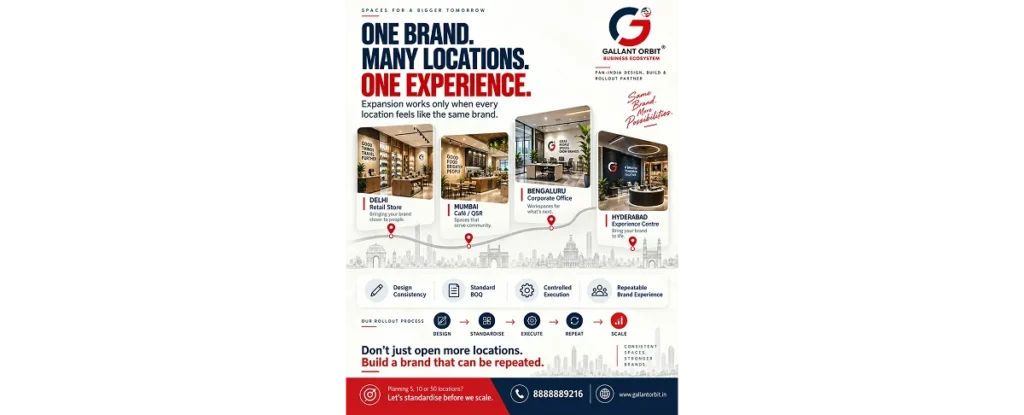
Gallant Orbit positions itself as a Pan-India Design, Build & Rollout Partner for businesses planning multi-location expansion. Its model brings together design consultancy, standardisation, BOQ development, turnkey fit-outs, project management, modular furniture, manufacturing and multi-city execution.
The approach can be understood through five simple stages:
Design → Standardise → Execute → Repeat → Scale
The objective is not simply to construct more outlets. It is to create a system that can be repeated efficiently from one city to another.
Let the Business Team Focus on Growth
Expansion already involves decisions around customers, products, franchise partners, marketing, operations and revenue. Managing every contractor and supplier personally can quickly become a distraction.
An integrated rollout ecosystem allows the business to decide where it wants to grow, while the execution partner focuses on how that growth is physically delivered.
This can be particularly relevant as brands move deeper into India’s emerging cities, where properties and local execution conditions may vary considerably.
For companies looking at retail design and build across multiple markets, standardisation can help create greater consistency while still allowing individual locations to respond to their specific site conditions.
The next phase of physical expansion may therefore not simply be about opening the maximum number of outlets.
It may be about opening locations faster, more consistently and with the same brand experience.
For brands looking beyond the metros, the question is no longer only, “Where should we open next?”
It is also:
“Can our business format travel successfully from one city to another?”
For companies with ambitious expansion plans, building a repeatable system can become an important part of managing multi-city growth.
One Brand. Many Locations. One Consistent Experience.
Gallant Orbit – Pan-India Design, Build & Rollout Partner